Malus
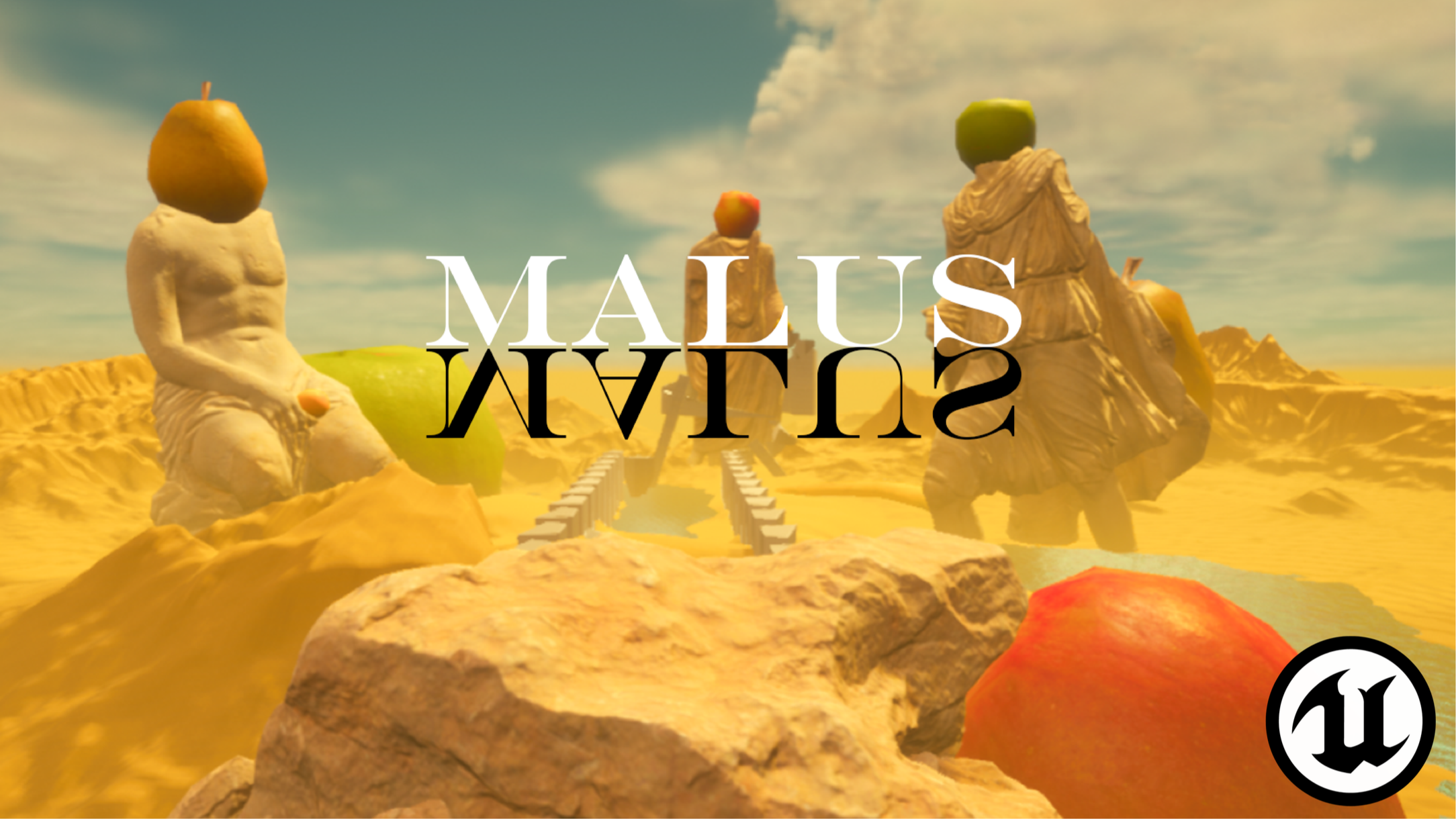
A surrealist exploration of humanity's end times. A space explorer traverses a Dalí-inspired desert landscape where scale, monuments, and fog evoke isolation, vulnerability, and wonder.
Overview
Malus places a space explorer in a surrealist landscape at humanity's end times, drawing visual and tonal inspiration from Salvador Dalí and Giorgio de Chirico. It represents a 10-week solo study of level design and player interaction.
Players navigate using WASD and Space to jump. The goal is to discover pink crystals that reveal upcoming map sections, ultimately guiding the explorer toward a golden apple where the journey concludes.
Design Philosophy
Linear with Illusion of Scale
The level design is fundamentally linear, but the open spatial layouts create an expansive, ominously surreal environment. Players feel freedom while being guided toward a singular conclusion.
Camera as Guide
Camera controls and architectural focal-point structures naturally direct player movement — no waypoints or HUD markers, just geometry and sightlines.
Scale as Emotion
Intentionally oversized objects — giant fruits, towering monuments — evoke vulnerability and surprise, making players feel physically small within the environment.
World Building
- Topographic scanning techniques created dynamic desert terrain with natural variation
- Skylights, ambient fog, and post-process color correction reinforce the surrealist atmosphere
- Architectural structures serve dual purposes — creating focal points while guiding navigation
- Pink crystals function as both collectibles and environmental storytelling devices
- The golden apple ending echoes the mythological connotations of Malus (Latin for apple)
Inspirations
Gallery